


Rust stains, another bane of exterior surfaces.
Like most woes, rust stains are one of our most annoying problems. Patio rust and driveway rust can appear out of the blue for no apparent reason; however, an underlying issue is nearly always causing the problem. This page helps explain how it appears and how to make your rust stain remover. It will also help you understand how to remove rust stains. It’s not always possible to remove, so many factors come into play; however, with some basic knowledge, it could be something you can attempt yourself.
Rust stains, whether patio rust, driveway rust, or even staining running down the side of your wall, are always a reason for their appearance. Later, we will discuss how to remove rust or make it look better.
Patio Rust Stains
So, let’s start on the patio. The most significant cause of patio rust stains is overenthusiastic lawn fertilisation. To grasp the origin of rust and how it develops, it’s essential to better understand the products you use in your garden.
Many fertilisers contain iron to help promote the healthy growth of your lawn. Be it pellet or liquid, fertiliser iron content can be pretty high. What we tend to see, especially on natural stone patios, is rust spotting. This occurs when pellets are scattered on the grass, but some land on the patio. The unsuspecting homeowner leaves them where they are, not realising the future damage they will cause. When left on a patio, moisture hits the area, and the oxidisation of the pellets, namely the iron, starts. As we all know, when water and iron mix, they turn to rust; this is the same with other metals such as steel…Voila! Rust stains.
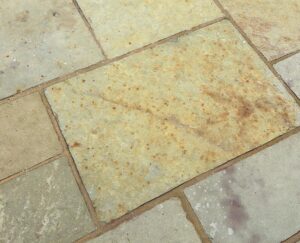
Fertiliser Stains on a Sandstone Patio
The Process
When mixed with water, the iron atoms turn to iron oxide or, as we all see it, rust. You will get patio rust stains from anywhere that metal comes into contact with water. The list could go on for garden furniture, ornaments, hanging brackets, and cast iron guttering. Garden furniture is another significant cause of patio rust; you may have noticed small rings around the legs of chairs or tables. Often, water gets trapped inside the legs and slowly dribbles out; along the way, this water picks up iron from within the unpainted metal. When this water is deposited on the floor, it will turn to rust; even bare metal furniture legs will cause it just by being on the ground. Read on, and we will help with a rust stain remover.
Stone Type
Not all rust stains are caused by furniture; yes, they are a significant contributor. Depending on the type of stone your patio is made from can indicate whether the patio rust stains you’re seeing could be more natural. Stone types such as granite, slate and some sandstone naturally contain a high iron content. The staining here will typically be more significant and widespread across the entire area. This is known as internal rusting, as the iron is contained within the stone and can take a while before it starts to show itself. Iron breakout from these types of stone can take months or even years to appear, and the downside to these types of rust stains is that, generally, there is no long-term fix.
Driveways
It is very similar to the patios above. However, we typically see different stone types used on driveways that we don’t always see on patios. Block paving and resin are the two most significant areas we don’t generally see used as patios. Driveway rust is also common; however, it’s not always as prevalent as on a patio. The biggest reason behind this is a majority of driveways don’t always have lawns around them and don’t typically have garden furniture. So, straight away, you have removed the two most significant causes of rust.
Block Paving
Let’s start with the most common driveway style, block paving. Driveway rust won’t be as common on block paving, mainly because the blocks are concrete and don’t tend to have iron content within them. Sometimes, tiny shards of metal end up in the blocks, but this is usually localised to a single block or two and not widespread. The only time block paved driveway rust is more common is if granite setts have been used. As discussed above, granite contains a naturally higher iron content. Over time, this can cause the blocks to turn an orange colour. This will be more apparent in areas with little shade or near drains and galleys that don’t dry out as quickly.
On traditional block paving, one of the leading causes of rust is skips; they are notorious for leaving significant rust stains. These, however, are superficial and are easier to remove. Interestingly, we have also found that metalwork can cause specific issues. Building works or external gate installations, etc. You will likely have rust spots if you use an angle grinder to cut metal. The metal particles or sparks, as you see them, fly everywhere, and you guessed it, it will turn to rust. Our dedicated block paving page can be found here.
Resin Driveways
You can find more on resin driveway cleaning here if you are interested in our services. I just wanted to touch upon rust stains on resin. They are virtually impossible to remove, sorry to say. The shear porosity of the driveway makes any chemical you apply soak straight through. There is almost no dwell time for chemical application on resin driveways. We have recently noticed that many of the stones used for laying driveways contain a significant amount of metal. One driveway we cleaned regularly had hundreds of small rust spots. Anything we put on them to help remove them didn’t work.
If your stone contains metal particles, you won’t be able to entirely remove rust stains until you remove those foreign metal objects.
Rust Stain Remover and How to Remove Rust
So we have touched up rust stains in general, but what can we remove them? Most common rust stain remover products contain an acid. Some acids are much stronger than others, and you should avoid using certain types altogether. For instance, don’t use hydrochloric acid or muriatic acid on driveway or patio stones unless you know exactly what you’re doing. People often refer to these acids as brick acids. Block paving is not a brick; one is concrete, and the other is clay; brick acid will dissolve block paving quickly. Using strong acids can cause irreversible damage and leave you a lot worse off than when you started.
Oxalic Acid
One of the most common universal rust stain removers contains oxalic acid. Oxalic acid is a mild acid derived from the leaves of rhubarb. It’s highly toxic, so don’t drink it. Oxalic acid brightens wood, removes tannin stains from oak, and helps with rust removal. Admittedly, it’s not as harsh as some products available, but as mentioned earlier, it will probably not come out if it’s deep within the stone.
You can buy oxalic acid in powder form. A simple solution of 1 part oxalic acid to 10 parts water should be enough to remove most cosmetic staining. You can also try iron fallout remover, used to clean alloy wheels. This turns purple in contact with iron and helps break down the iron oxide that causes rust stains. As with most products, it can take several applications. This is one of the reasons why most cleaning contractors won’t guarantee rust removal simply because it’s not always possible to do it in a single visit. If you want us to come back and keep trying, it adds to the cost. This is why rust stain removal is typically something homeowners should try to undertake themselves. Hitting it with a pressure washer won’t do anything, as you’re not breaking down the iron oxide.
Dwell Time
Always be careful with any product you use. Don’t leave it down too long. Twenty minutes is usually long enough; rinse and repeat if necessary. Make sure you understand what the product is and what’s in it. Please don’t use it on acid-sensitive stones like limestone. We have witnessed excessive damage caused by acid scorching from the use of strong acids. Make sure you wear protective gear, gloves, and a mask, which are usually essential when dealing with any acid.
That’s it on the subject. Please feel free to contact us if you need any cleaning work undertaken. Advice is free. WhatsApp us on 07585293902 or scan here.

WhatsApp Us Today
Check out our other pages that may be of interest.
Have a look at our YouTube and Facebook Pages
Dirty Drive-Away YouTube Channel
https://www.facebook.com/dirtydriveaway