


Block Paved Driveway Sanding
We are often asked why block pave driveway sanding is necessary and how best to do it. We added this dedicated block pave sanding page in response to these questions and enquiries.
A cushion of kiln-dried sand sits between the blocks, or pavers, as often referred to. This sand is very fine and should be bone dry to ease installation. When swept into the joints, it adds strength and rigidity. Upon initial installation, a compactor or whacker plate would have been used to facilitate the bedding down of the pavers and jointing sand.
After you clean any block paved area, you will lose some jointing sand in the washing process. This is normal and is the only way to clean the area without leaving behind weeds and moss. Let’s face it: that’s one of the main reasons you wanted it cleaned in the first place. Softwashing, another way of cleaning, doesn’t remove weeds and moss. This method relies on chemicals to remove the dirt. In turn, you get very little sand loss, but at the same time, it has little effect on eliminating weeds. Moving on…
The cleaning process
To fully understand the reason behind block pave driveway sanding, or resanding as it’s often called, it’s best to know exactly how much sand is lost during a regular cleaning operation. From experience, you can expect to lose around 5-10mm of jointing sand. This equates to approximately 10-20% of the block depth. This sounds like a lot, but in reality, it isn’t. Let us put that into perspective with some crude Photoshop skills on some pictures.

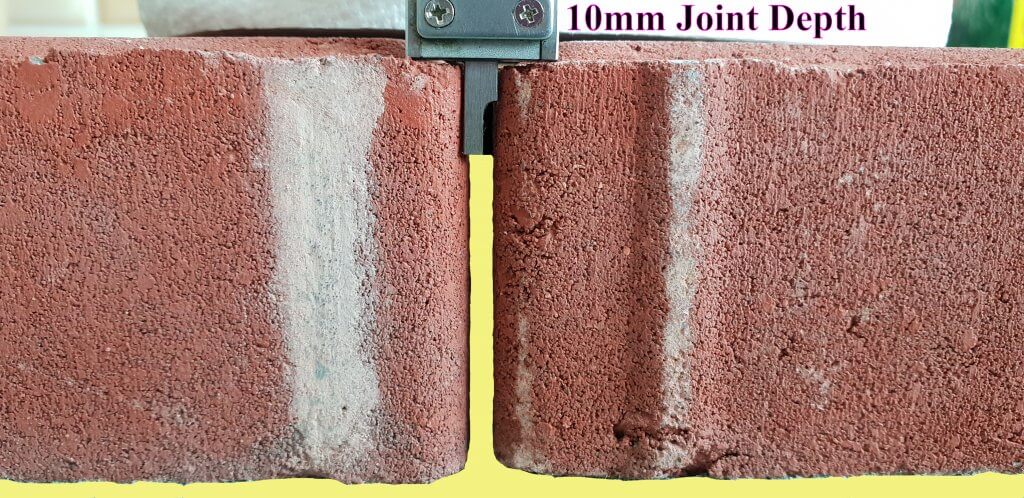
The yellow lines represent the sand. You can see that a standard 50mm paver experiences minimal sand loss. After cleaning, the joint sand will be topped up, retaining the area’s aesthetics and strength.
The amount of sand lost during cleaning largely depends on the joint width. Typical gaps range from 1.5mm (tight) to 8mm (wide), with a standard gap width of around 3mm. If the spacing is too tight or the blocks are touching, getting sand between them thoroughly can be tricky. On the flip side, if the spacing is vast, more sand will be used, and the chances of weather-related sand wash will be higher.
How much sand will it need?
Generally, we base block pave sanding on 20sqM per 20KG bag. Different styles of pavers can use more sand than others. For example, we tend to find that blocks in the “Tegula” style have more rounded and chamfered edges. This tends to lead to slightly more sand consumption. As pictured above, we would follow the 1KG per sqM guideline for standard block pavers. It’s better to have too much than not enough.


The pictures above show that the “Tegula” style has more rounded edges than the standard 200×100 pavers. These rounded “tumbled” blocks can need a bit more sand than conventional bricks.
Sanding Method
Sanding is relatively straightforward and requires no special tools. You only need a few bags of kiln-dried sand and a good broom. There is no right or wrong way to do it; just sweep it in.
If you want to see how we clean and resand a block paved driveway, watch this video on our dedicated YouTube channel. https://youtu.be/m9m7VIaQbMY
Do you need a whacker/compactor plate when resanding?
Another common question or misconception is the use of whacker plates after cleaning. In short, the answer is NO; you don’t need to use a compactor plate. Since you are only topping up the joints, using a whacker plate is unnecessary, as there is nothing to compact. The fine sand will drop into the open joints if done correctly. Due to popular misconception, we made this video to explain why https://youtu.be/6DrYBeICge4.
Keeping the Sand In
One of the biggest bugbears of block paving is keeping the sand in the joints. We’re often asked why so much sand gets lost over time; the main reason is rain wash. Running rainwater will likely wash away some sand if your driveway or patio is on an incline. You can do a couple of things to help with this issue: apply a sealer to bind the joints or use polymeric jointing sand.
Sealing’s covered on our other page, found here. The basics are that applying a sealer sets the joint sand hard, thereby stopping sand loss and helping prevent weeds. Polymeric sand is another alternative; these sands have binders to set the sand. This, again, works similarly to sealing but usually works out cheaper as it’s less labour-intensive. The downside to using polymeric sand is that when used as a joint top-up, only the replaced sand sets hard; it doesn’t penetrate as sealer can.
Well, that’s all there is on this subject; if you have any questions, please feel free to get in touch. You can navigate our site using the drop-down boxes above, or here are links to some of our popular pages.
We like our customers to leave us reviews on Facebook, so look at our page.


Block pave driveway sanding. Bromley Kent, Beckenham, Sidcup, Chislehurst, Orpington, Sevenoaks, Bickley, Bexleyheath, Bexley. BR, TN, ME. Block pave driveway cleaning and pressure washing.