


The bane of all driveways & patios. Oil stains.
To some extent, oil stains on a driveway or patio can be removed. Yet, there is a pretty big but.
If you’re looking for a cleaning quote, please don’t hesitate to get in touch. We may not be able to completely remove your oil stain, but we can certainly make it look significantly better. Please send some pictures, your sizes (if known), and your location to dirtydriveaway@gmail.com or WhatsApp to 07585293902. We’d appreciate it if you could provide us with as much information as possible so we can deal with your question more efficiently.
Help! I have an oil stain.
Whether it’s a driveway oil stain, a patio oil stain, or a block paving oil stain, let’s dig deeper into this common problem. You’ve noticed that your car has developed a leak, and your lovely drive now has a stain. You have just hosted the most amazing BBQ, and everyone’s boasting about your insane cooking skills, but you have found grease or oil stains on your patio from an over-enthusiastic hot dog lover. It doesn’t matter if you have block paving, sandstone or even porcelain. Driveway oil stains (and patio, too) can be a headache to remove entirely.
Do you know what I can do?
Honestly, oil stains can be a nightmare to remove fully. Please don’t wait; the best practice is to be sure to scrub it as soon as you see it. The longer you leave it, the harder it becomes to remove. Depending on the type of stone, it will determine how hard it is to remove. Natural stone is quite porous and will absorb the oil much quicker than concrete or block pavers. Speed is of the essence; as a general rule, you have around 7-14 days to act on it. After this time, the complete removal becomes increasingly complex to achieve.
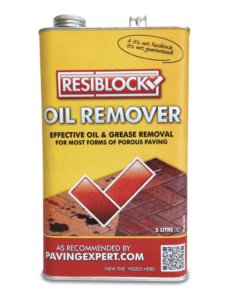
Proprietary oil stain remover from Resiblock.
So what’s the driveway oil stain miracle removal product? Tell me, please.
There are hundreds of products on the market designed for removing driveway oil stains. Read the small print on most of them, and it will say the same, “for best results, use as soon as the oil is present”. This doesn’t give you a massive window. If you notice an oil stain or grease mark on your stonework, the first thing to do is try good old washing-up liquid. Squirt it on neat; it’s cheap, so don’t hold back. Then give it a good scrub with a stiff brush, a washing-up brush, or a nail brush, which is ideal. You may need to apply a little water to get some foam going.
Seriously, washing up liquid?
Yes! This should be your first quick-try method. After applying the neat liquid, give it a gentle scrub with a brush, then rinse it with boiling water. The liquid should help to dissolve the oils, whilst the boiling water helps to melt away the fats. If you have caught it quickly enough, you may have removed it. It will need to dry to be sure.
Washing-up liquid didn’t work; what now?
You may find you have removed the dark colouring from the oil stain. For example, if it’s engine oil, you may find that the blackness has gone but left a residual mark on the stone. This is known as ghosting; you may need to apply a special product to lift the mark or use a poultice to reabsorb the stain.
The problem with natural stone is that using harsh chemicals can cause damage or alter its appearance. A poultice can be made using whiting powder and left to re-absorb the stain for 24 hours. It’s not guaranteed it will all work, as the longer the oil has been sitting, the deeper it will have penetrated.
Somebody said to try brick acid.
The clue is really in the name, brick. A brick is made from fired clay and can handle some strong acids. It is, however, too strong to apply to a patio or driveway. Any acid will dissolve block paving as it’s made from concrete. You will do more damage using acids than any other product can cure.
Block paved driveway oil stains.
Now, let’s examine a block-paved driveway with significant oil stains. Again, these can be very difficult to remove effectively, even with dedicated products. Your timeframe for this surface is usually around a week or so. Dedicated oil removal products can be expensive; some are not much more than kerosene. Something as simple as thinners can dissolve oil, provided it’s scrubbed and rinsed thoroughly afterwards.
Here is a before-and-after shot of a driveway with extensive staining. The staining was there when they moved in, and had been there for at least two years. The probability of removing the stains was quite slim. We used only a proprietary oil remover and a good scrub.
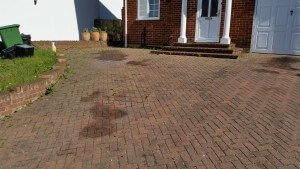
Nasty Oil Stains on Block Paved Drive

After a Pre Treat & Clean
Results.
The stains weren’t entirely removed, but they are better. The customer didn’t want to spend money on treatments that may or may not work. Most treatments involve leaving the product in place for 24 hours or more, which adds to the cost. The best way to avoid such widespread oil stains is to fix the car or keep it in one place and put a board underneath it.
Another Method.
If the oil stains are localised to a few blocks, it is usually cheaper to replace the stained ones. This type of driveway appears expensive, and indeed, it is. However, the blocks start from around 40p each, so replacing two or even eight blocks isn’t costly. They will look new and need to weather for a bit to blend in. Alternatively, could you remove blocks from an inconspicuous area and replace them with new ones?
Based in Bromley (Kent), we cover BR, DA, and some parts of Kent.
Other pages on our site that may be of interest.
Softwashing
Deep cleaning
Block Paving
Natural Stone
About Us
FAQ
We like our customers to leave us reviews on Facebook, so have a look at our page.


We also have our own YouTube channel full of cleaning videos, help, advice, etc.
https://www.youtube.com/dirtydriveaway
Offering pressure washing and external high-pressure jet washing around Bromley and the surrounding areas. Pressure cleaning service Bromley, Beckenham, Petts Wood, Orpington, Sidcup, Sevenoaks, Bexleyheath, Bickley and beyond. We do not cover London postcodes (e.g., SE, SW, etc.).